

A red team engagement is only as good as the adversary it simulates.
Most red team engagements start from a generic playbook: a phishing pretext, a handful of known exploits, maybe a password spray. That finds real gaps. It also misses the ones that matter most, the techniques an actual adversary targeting your industry is using right now.
Real threat intelligence changes that. Instead of guessing at attacker behavior, a red team can pull real campaign data: which threat actors are active against organizations like yours, what techniques they favor, and what infrastructure they've been caught using.
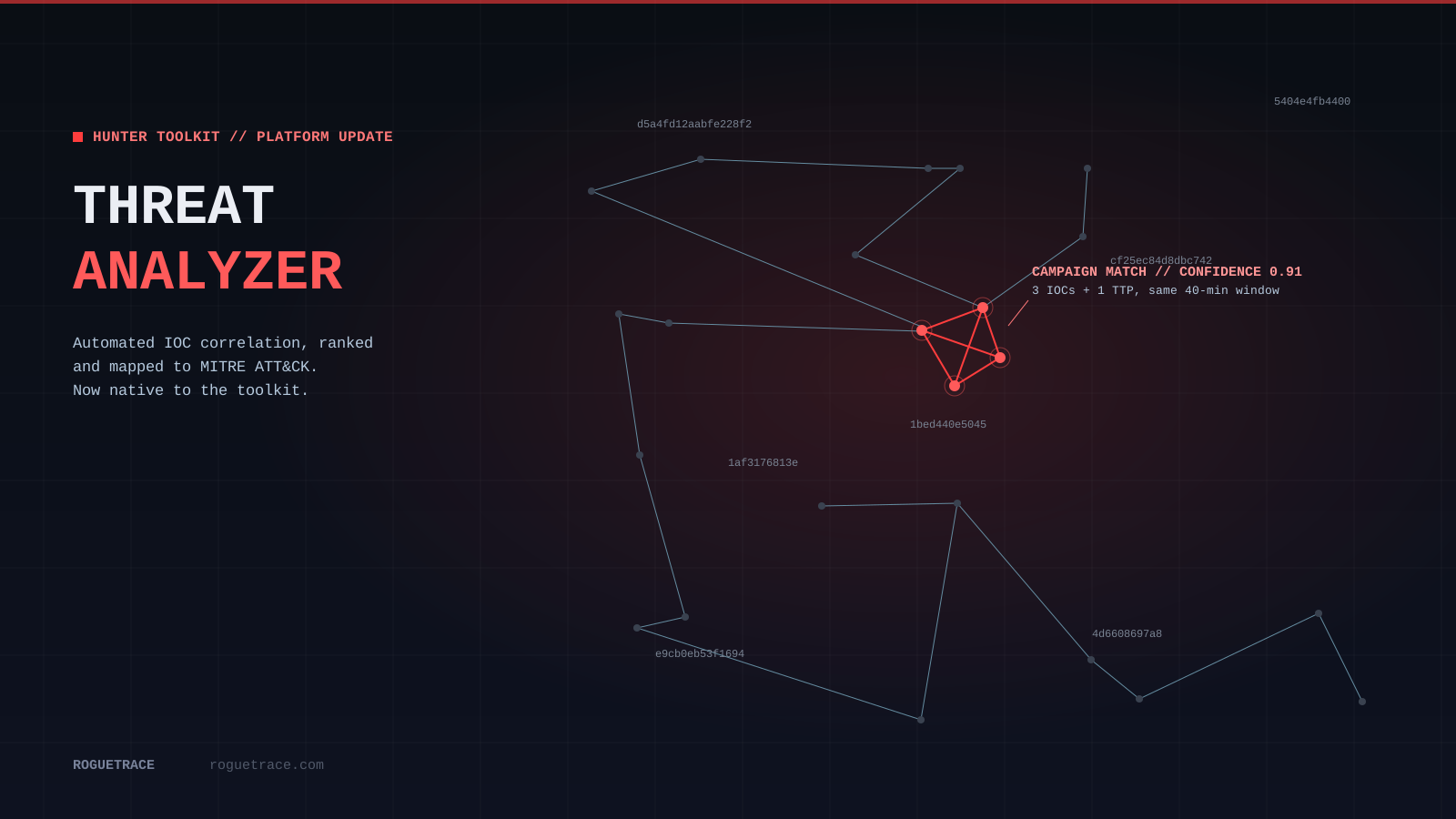
RogueTrace's Threat Analyzer is built for exactly this. Ask it a plain-language question, such as which techniques a specific ransomware group has used against companies in your sector, and get back structured intelligence pulled from live dark web feeds, submitted threat research, and APT databases, already grounded in MITRE ATT&CK and Sigma context. That turns a vague assumption into a specific, testable engagement plan.
The best red team engagements simulate a real adversary's actual playbook, not a generic checklist.
Mapping the Engagement to the MITRE ATT&CK Chain
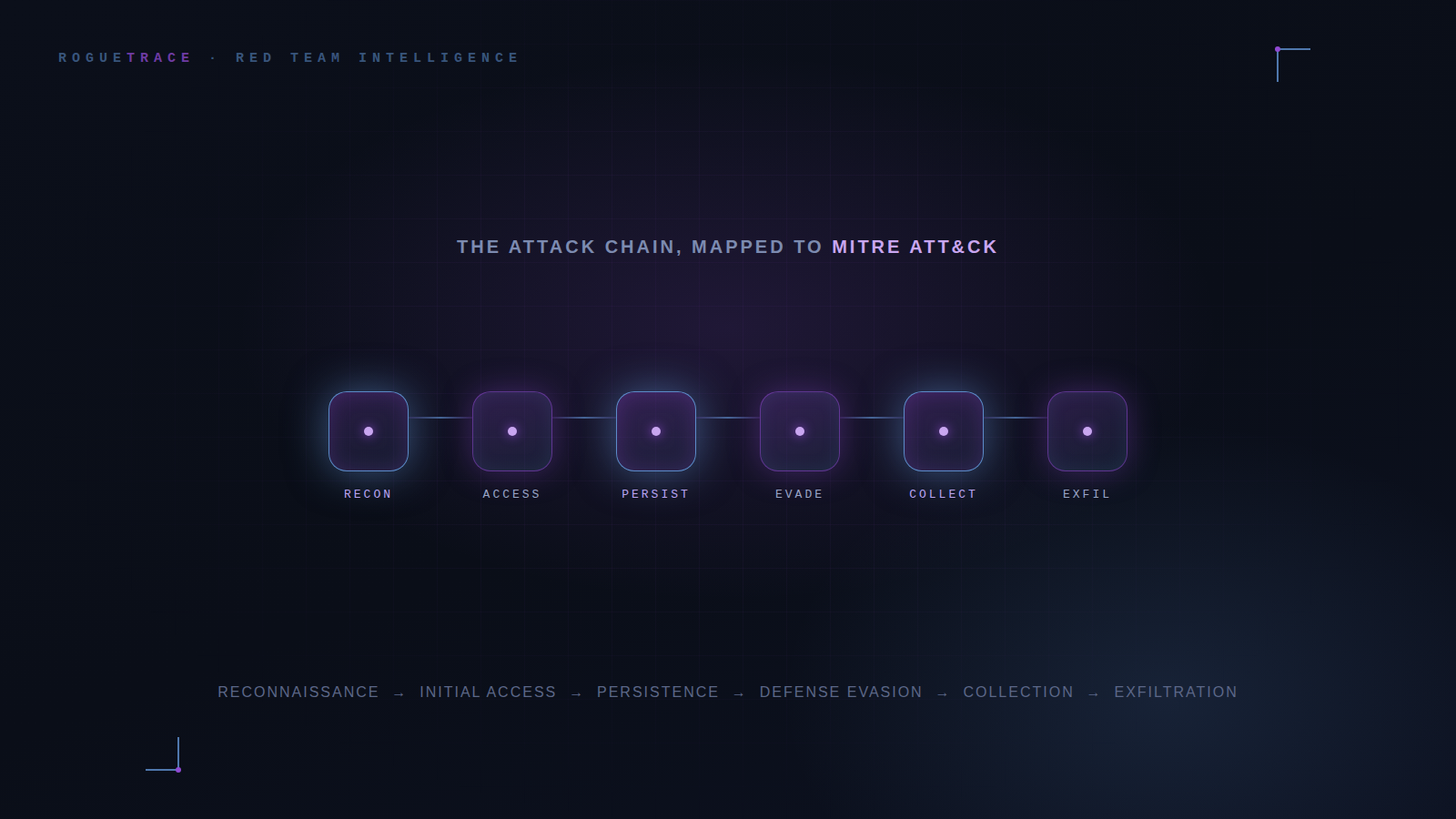
MITRE ATT&CK is a public knowledge base of how real attackers operate, organized into a chain of tactics: reconnaissance, initial access, execution, persistence, privilege escalation, defense evasion, credential access, lateral movement, collection, and exfiltration.
For red teamers, that chain is a planning tool. Instead of jumping straight to "let's try phishing," a researcher walks the chain step by step: how would this specific actor get in, what would they do once inside, and how would they get data out?
Each stage maps to named techniques with their own IDs, like T1566 for phishing or T1055 for process injection. When Threat Analyzer surfaces intelligence on a threat actor, it ties that intelligence back to these same ATT&CK techniques, so an engagement can mirror a real adversary's actual attack chain instead of a generic script.
- Pick a threat actor relevant to your industry
- Pull their known techniques by ATT&CK stage
- Sequence the engagement to match their real attack chain
Sigma Rules: Turning Findings into Detections
An engagement isn't finished when the red team gets in. The real value comes from what the blue team does next, and that's where Sigma comes in.
Sigma is an open, vendor-agnostic format for writing detection logic. Write the rule once, in a structured, human-readable format, and convert it into the native query language of almost any SIEM, Splunk, Elastic, Microsoft Sentinel, and more, without rewriting it for each platform.
When a red team successfully executes a technique that goes undetected, that's a direct signal: there's a detection gap for that specific ATT&CK technique. Because Threat Analyzer results are also grounded in Sigma context, a researcher can look up the technique and immediately see what detection logic already exists for it, or confirm the gap is real.
That closes the loop. The red team finds what an adversary would actually do. MITRE ATT&CK gives it a name and a place in the attack chain. Sigma turns it into a rule the blue team can deploy before the next engagement, or the next real attacker, tries the same thing.
Threat intelligence isn't just for finding attackers. It's what makes red and blue teams sharper together.