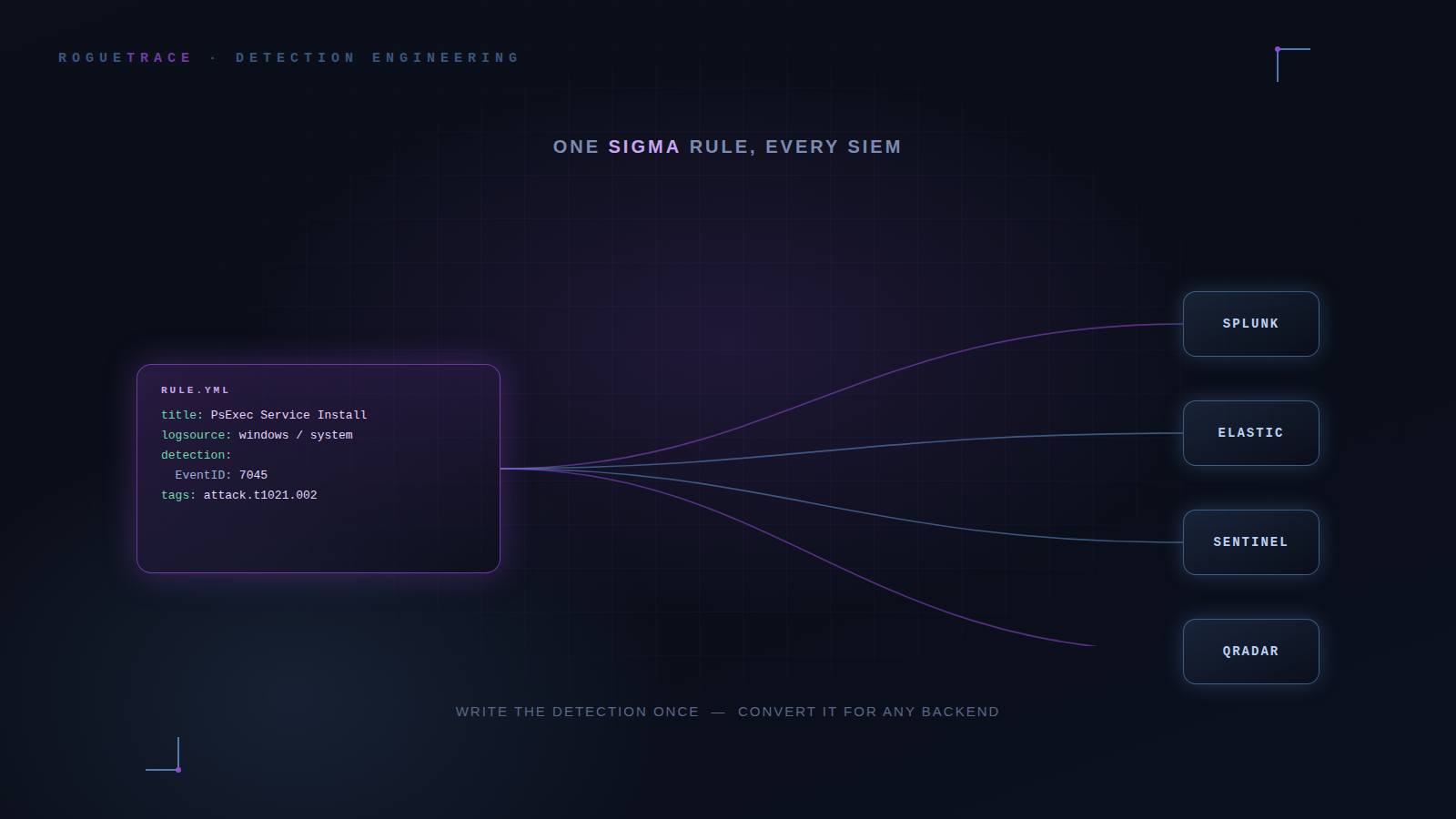
Write the detection logic once, deploy it to any SIEM — that's the pitch behind Sigma, and it actually holds up.
Most detection logic dies with the platform it was written for. A Splunk SPL query doesn't run in Elastic. A Sentinel KQL rule doesn't run in QRadar. Every time a team switches SIEMs, swaps vendors, or just wants to share a detection idea with another org, the rule gets rewritten from scratch — or it doesn't get shared at all.
Sigma exists to close that gap. Created in 2017 by Florian Roth, it's an open, YAML-based format for writing detection rules in a way that isn't tied to any single query language or product. The common framing in the detection engineering community: Sigma is what Snort is for network traffic and YARA is for files — a shared syntax for describing "this is what a bad thing looks like in the logs," independent of where those logs end up being searched.
What a Sigma rule actually looks like
A Sigma rule is a structured YAML document with a small, consistent set of sections:
- title / description — what the rule detects and why it matters
- logsource — which log category the rule applies to (Windows Security events, Sysmon, cloud audit logs, firewall logs, etc.)
- detection — one or more named selections of field-match conditions, plus optional filters to exclude noise
- condition — the boolean logic combining those selections (e.g. "selection and not filter")
- metadata — severity level, author, references, and tags — including direct MITRE ATT&CK technique IDs
That last point matters more than it looks: because a Sigma rule's metadata can carry an ATT&CK technique tag directly, detection coverage and technique coverage become the same dataset instead of two spreadsheets someone has to keep in sync by hand.
A Sigma rule's metadata tags its own MITRE ATT&CK technique ID, so detection coverage and technique coverage stay as one dataset instead of two.
Here's a real, simplified example — a rule that catches a classic lateral-movement move: using PsExec to remotely install and run a service.
title: PsExec Service Installation
description: Detects PsExec service installation via Event ID 7045
logsource:
  product: windows
  service: system
detection:
  selection:
    EventID: 7045
    ServiceName|contains: 'PSEXESVC'
  condition: selection
level: medium
tags:
  - attack.lateral-movement
  - attack.t1021.002
That one YAML file is the entire detection. It doesn't know or care whether it ends up running in Splunk, Elastic, or Microsoft Sentinel — that translation step is handled separately, by sigma-cli, the modern successor to the now-deprecated sigmac converter. sigma-cli is powered by the pySigma library and a set of backend plugins installed per target:
pip install sigma-cli
sigma plugin install splunk
sigma convert -t splunk -p splunk_windows rule.yml
The -p splunk_windows flag is a pipeline — a mapping layer that translates Sigma's generic field names (like ServiceName) into whatever field names that specific log source actually uses in that specific backend. Swap the target and pipeline flags, and the same rule.yml converts cleanly for a different SIEM, no rewrite required.
This is also why Sigma's community repository, SigmaHQ, has become a genuine shared resource rather than a vendor's walled garden: over 15,000 community-contributed rules, each one usable regardless of what a given team runs downstream.
Where this earns its keep is in the loop between red and blue teams. In purple-team engagements, a red team executes a specific ATT&CK technique and the blue team checks, in real time, whether an existing Sigma rule actually fires on it. No rule firing means a documented detection gap — not a vague "we should probably look at that," but a specific technique ID, a specific log source, and a specific rule that needs to be written or tuned.
Mature teams wire this into CI/CD rather than running it ad hoc: Sigma rules live in version control alongside application code, get converted automatically on every merge, and deploy to the SIEM through its API as part of the same pipeline that ships everything else. A rule change is reviewed, tested, and shipped the same way a code change is — because at that point, it is one.
This is also the detection-side half of what we covered in the ATT&CK framework breakdown: ATT&CK gives you the shared vocabulary for what an attacker did; Sigma gives you the shared, portable way to prove whether you'd actually catch it. On the Threat Map and Threat Analyzer, that technique-to-detection link is exactly what RogueTrace tracks across the threat actors and TTPs we monitor.
Sigma turns detection logic from a vendor-locked query into a shareable, testable artifact — which is the whole point, since a detection rule nobody else can run might as well not exist. Next in this series: detection only matters if it's pointed at the right indicators, which is exactly the gap dark web monitoring closes.