Not a single analyst scrolling through Tor with a notepad — a hybrid pipeline of crawlers, machine learning, and people willing to go where scrapers can't.
"Dark web monitoring" covers more ground than the name implies. It's not one network — it's Tor, I2P, ZeroNet, encrypted Telegram channels, paste sites, ransomware leak blogs, and invite-only criminal forums, each with different access rules and different reasons something ends up posted there. Effective monitoring has to cover all of it, because a credential dump might surface on a public paste site while the negotiation over a ransomware victim's stolen files happens entirely inside a closed Telegram channel.
The scale of what's actually out there is not small. Security researchers cataloged a compiled set of 16 billion stolen credentials spread across 30 separate dark web databases in 2026, with 184 million of those records specifically tied to enterprise and government systems. That data doesn't sit idle: F5 researchers found that nearly one in three login attempts across monitored enterprise environments in 2026 now use credentials sourced from known leaked compilations — meaning this isn't archival data, it's an active attack tool being used right now.
What's actually doing the crawling
On the open and semi-open layers — indexable marketplaces, public paste sites, searchable forums — monitoring runs on automated crawlers purpose-built for hidden services: tools like TorBot systematically walk .onion links and extract page content into structured data, while OnionScan checks individual sites for metadata and configuration exposure. Cyble tracked 6,046 global data breach and leak incidents in 2025 alone through this kind of continuous indexing, feeding natural language processing models that parse unstructured, often deliberately obfuscated forum text into something searchable.
Security researchers have documented a roughly 48-hour window from an infostealer infection to that machine's stolen credentials going up for sale — monitoring has to be continuous, because the gap between compromise and exposure is now measured in hours.
Automation only gets you so far, though. The highest-value intelligence — a ransomware group naming its next victim, a broker quietly shopping an enterprise database before it's publicly listed — usually lives inside closed, invite-only communities that actively fingerprint and block scraper traffic. That's where human intelligence (HUMINT) takes over: analysts operating sockpuppet accounts, earning or buying invite codes into restricted groups, and reading multilingual criminal chatter (Russian- and Chinese-language forums carry a disproportionate share of serious enterprise intrusion activity) well enough to tell a credible threat from a scammer's exaggerated listing.
What comes out of either channel — automated or human — gets run through keyword and entity matching against what an organization actually cares about: domains, executive names, employee emails, product codenames, specific data formats like credit card numbers or API key patterns. A hit doesn't become a raw data dump in someone's inbox; it becomes a scoped alert with validation context (what was found, where, when, and a confidence rating) routed into a SIEM, a ticketing queue, or a Slack channel — the same alert architecture, not coincidentally, that a well-tuned Sigma rule produces on the detection-engineering side. The two disciplines are solving the same problem from opposite ends: one watches for the indicator showing up outside your network, the other watches for what an attacker does with it once they're inside.
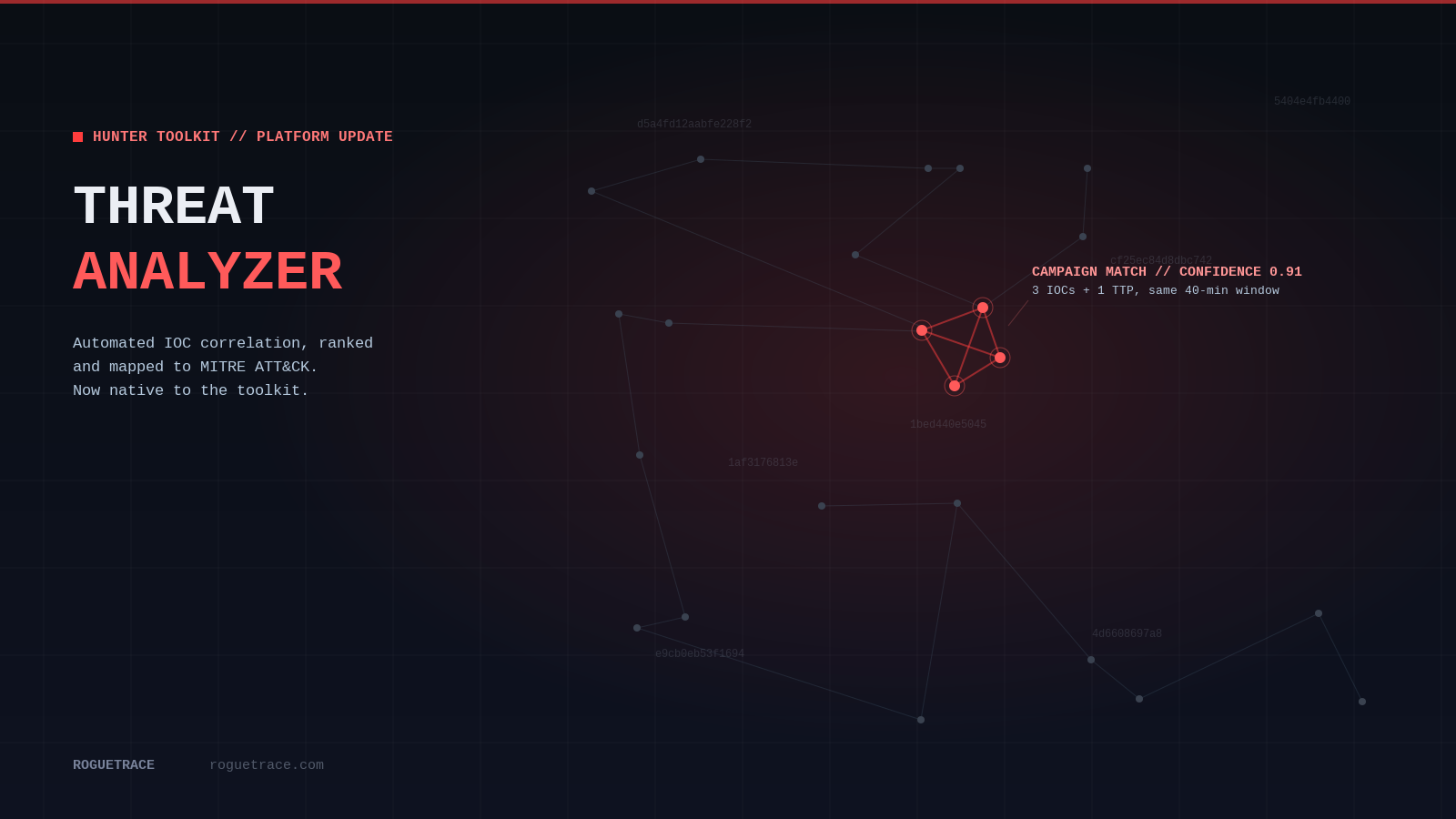
This is the exact data model behind RogueTrace's own Threat Map, where dark web markets are tracked as one of four core categories alongside APT groups, ransomware syndicates, and organized crime networks — continuously updated rather than reported after the fact. Ask the Threat Analyzer a plain-language question about a specific actor, marketplace, or TTP and it answers from that same real-time intelligence, grounded in MITRE ATT&CK and Sigma context rather than a static report that was already stale when it published.
The point of watching the dark web was never the watching itself — it's what a team does in the window between a credential surfacing and an attacker using it. Start with free credits and see what's already out there tied to your own domain.
Monitoring the dark web isn't a single tool or a single technique — it's automated crawlers, entity matching, and human analysts willing to go where scrapers get blocked, all feeding the same alert pipeline. That closes out this round of deep dives; the fundamentals — ATT&CK, Sigma, and now dark web monitoring — are the same three legs RogueTrace's own platform stands on.